A Rain-Softened Pitch: What to Watch in the Opening Minutes
Watch a rain-softened pitch closely in the opening minutes to spot how players adjust their passing, turns and touches before the match settles.
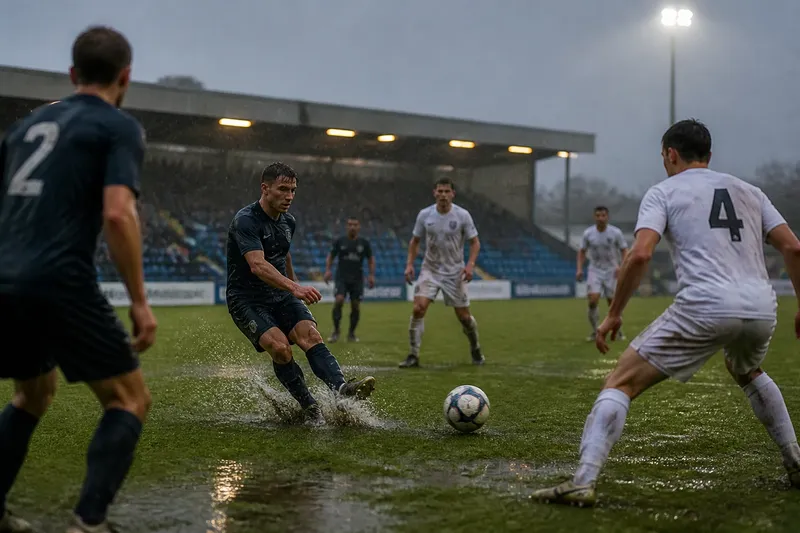
A rain-softened pitch changes the feel of the ball before it changes the shape of a match. In the opening minutes, watch the first short pass, the first turn under pressure and the first ball that skips or holds up. Those moments show whether players are adapting their technique, avoiding certain areas or asking teammates to solve the problem for them.
One slick pass proves little. A pattern matters more: a midfielder checking before receiving, a defender choosing a safer angle, or a striker changing the timing of a run after a pass slows on the grass. Treat early errors as clues, not verdicts. Rain can leave one patch quick and another soft, and players need time to learn which is which.
Start with the ball’s first movement
For a rain-softened pitch, the first useful question is not simply whether the ball is moving quickly. It is whether its speed and direction are predictable. A wet surface can make a ground pass glide, while a soft patch can reduce its pace. The ball may also change course after crossing a worn or uneven area.
Watch a routine pass between defenders. Does it reach the receiver cleanly, or does it run ahead of the intended foot? Then watch a pass played across a different part of the field. If the same weight produces a different result, the players are dealing with local variations rather than one uniform surface.
The receiver’s preparation matters as much as the pass. A player who opens the body early can use a less exact ball without needing an extra touch. A player square to the passer may have to stop, adjust and look up again. That pause can let a press arrive, even when the pass itself is reasonable.
Do not count every hurried touch as a pitch problem. A defender may be rushed by an opponent; a midfielder may have been given an awkward pass because a teammate chose the wrong lane. Look for the same kind of adjustment recurring across separate possessions. The surface is a plausible cause when several players make similar choices in similar ground conditions.
Read short passes that run away
A short pass that travels farther than expected often exposes a familiar early-match problem: the passer uses the weight that worked on a dry surface, while the ball responds to the wet one. The receiver may reach for it, take it toward the sideline or lose the chance to play forward in one touch.
Watch what the team changes next. A passer may take pace off the ball, aim at the receiver’s safer foot or choose a slightly shorter lane. The receiver may stand nearer, present a wider angle or let the pass come across the body rather than meeting it head-on. These are small adaptations, but they can keep possession from turning into a contest for a loose ball.
If the next few passes remain overhit, ask whether the team is trying to force the same route. A narrow passing lane can be risky on slick grass because a deflection may send the ball beyond both intended players. The obvious adjustment is not always to stop passing short; it may be to move the receiver a step, change the angle or use a supporting player before advancing.
Say a team’s left-sided defender sends two ground passes toward a midfielder, and both skid beyond the player’s stride. On the next possession, the midfielder drops closer and shows toward the touchline; the defender plays into that wider angle, and the receiver controls without breaking stride. The observable change is not a sudden improvement in the pitch. It is a better match between pass, distance and body position.
Check whether turns become difficult
A player can receive a pass cleanly and still struggle to turn. On a softened surface, a planted foot may slide, or a player may avoid putting full force through a sharp change of direction. The result can look like indecision: a touch backward, a layoff to a teammate or a turn abandoned halfway through.
Watch the player’s hips and supporting foot, not only the ball. If a midfielder repeatedly receives side-on but chooses to return the ball instead of turning into open space, the player may be protecting balance or avoiding a risky pivot. If the same player turns comfortably when the ball arrives at a slower pace, the issue may be the combination of speed and footing rather than reluctance to attack.
For the team, the practical response may be to offer a nearby outlet and let the receiver play around pressure. A forward can check toward the ball, a fullback can hold a wider position, or a second midfielder can move beyond the receiver rather than crowding the same space. These options reduce the need for a sharp turn without requiring the team to abandon forward movement.
Compare turns in different areas, too. A central patch may be soft from repeated traffic, while the grass near a sideline remains firmer. If players turn more readily in one zone, the difference helps explain why a team keeps moving possession toward that side. Do not assume the choice is a planned tactical switch until it recurs; a single safe pass is just a single safe pass.
Notice when the ball holds up
Not every wet surface makes the ball race away. Soft ground can absorb pace, leaving a pass short or making a rolling ball hesitate. This creates a different problem: the intended receiver may have to come back toward the ball, while an opponent closes from behind or across the passing lane.
Look at passes played through the same channel. If they repeatedly lose speed in one strip of grass, teammates may begin to shorten their runs or ask for the ball to feet. A player who continues running beyond the pass can arrive in the right space after the ball has stopped being useful. Timing, rather than effort, is the issue.
A team can respond by playing with more margin. The passer can put the ball closer to the receiver, and the receiver can check their run before accelerating again. Another option is a pass across firmer ground, followed by a change of angle. The useful sign is that the next move accounts for the ball’s reduced pace instead of treating every pass as if it traveled cleanly.
Be careful not to label every interrupted attack a soft-ground effect. An opponent may have covered the route well, or the passer may have misjudged the distance. The surface becomes a stronger explanation when the ball slows in the same location and players begin changing their running lines around it.
Track the bounce on aerial and second balls
Rain can make a bounce awkward in either direction. A ball landing on a wet, firm patch may spring up; on saturated or soft grass, it may stay low. The important detail is whether the bounce matches the player’s expectation. A defender who sets for a chest-high rebound may be caught reaching down, while a forward expecting a ball to hold may find it skipping beyond.
Watch the first aerial clearance that lands in open space. Do nearby players move to where the ball should be, or adjust after its first bounce? A player who waits to judge the bounce may gain control; one who commits too early can be forced into a recovery touch. The ground duel after the landing can reveal more than the original header.
Teams may alter how they contest these balls. A defender could clear toward a teammate rather than into a crowded central area, while a midfielder positions to collect the second ball instead of joining the first challenge. A forward might angle a run toward the likely rebound rather than chasing the ball’s original path. These choices are useful to watch because they show adaptation in spacing, not merely individual technique.
Do not infer a deliberate change from one misjudged bounce. A player may have been screened, or the ball may have struck another player first. Wait for another comparable landing and see whether the nearby players adjust their starting positions or approach.
Why do players keep slipping?
Does a slip mean the pitch is unsafe?
One slip does not establish that the whole surface is unsafe. Watch whether players lose footing in the same area and whether their movements become cautious there; serious concerns about playing conditions are for match officials and qualified grounds staff to assess.
Why does the ball skid in one area and stop in another?
Water does not affect every patch equally, and wear, drainage and accumulated traffic can change how grass responds. Compare passes through different lanes before deciding that one team is simply mishandling the ball.
Should a team stop playing short passes?
Not automatically. If short passes keep running beyond receivers, players can adjust their weight, angle and distance; if a particular lane repeatedly slows or takes an awkward bounce, changing the route may be more sensible.
How long should I wait before calling it a pattern?
Look for repeated, comparable moments rather than a fixed number of minutes. An adjustment becomes easier to identify when different players make the same change in response to similar passes, turns or bounces.
Separate surface clues from tactical choices
The surface can influence a team’s decisions without explaining all of them. A side may already prefer direct passes, and a wet pitch may make that choice more pronounced. Another team may keep the ball because it wants to draw pressure, even if a few passes skid away. Read the surface alongside the players’ positions and the opponent’s pressure.
One useful distinction is between a technical adjustment and a strategic one. A passer taking pace off a short ball is adjusting technique. A team moving possession away from a repeatedly troublesome channel is changing its route. A defender clearing long because the opponent is pressing tightly may be responding mainly to the opponent. The same long pass can serve more than one purpose, so look at what the team does after it.
Also watch whether the opponent adapts. If one side begins directing passes toward a slow patch, the other may step closer to contest the receiver or station a player near the likely loose ball. That response can turn a surface issue into a tactical contest. The pitch has not chosen a side; it has changed the cost of certain decisions.
What is not worth the effort
It is not worth diagnosing the whole match from a single slip, one heavy touch or a close-up view of water on the grass. Broadcast angles can hide changes in slope and texture, and the ball may have taken a deflection that the camera does not make obvious. A confident explanation built on one odd bounce is still a guess, only with better posture.
Instead, compare similar actions and keep the observation concrete: this pass ran ahead; that turn was abandoned; this ball slowed in the same channel. Then note the adjustment that followed. You do not need to decide whether the surface is good or bad to notice how players are coping with it.
Use the opening minutes to update your read
For a rain-softened pitch, the opening minutes are a chance to see which actions remain dependable and which need alteration. Follow ground passes for excess speed or lost pace, watch the supporting foot on turns, and judge bounces only after the ball lands. Look for players changing the next attempt, not merely reacting to the last one.
A useful matchday note can be simple: where the ball behaves unexpectedly, who adapts, and whether teammates give that player a better option. Keep the note provisional. As the game unfolds, the surface may remain uneven, the rain may ease, or the teams may solve the problem through positioning. The strongest early clue is often not a mistake but the next pass, made with a little less force and a little more thought.